

LAIA designs the flow; the flow handles the follow-up
LAIA edits your sales and retention flows right inside the editor, always as a draft so you can review them. And in her chat she tells you at which step your sales are slipping away and suggests a new flow. The 35 ready-made flows are in the CRM module.
You set when a task is due and the system closes it on time
You set the due date or the cycle of a CRM task. The system closes or repeats it on its own, with nobody having to keep an eye on a calendar.
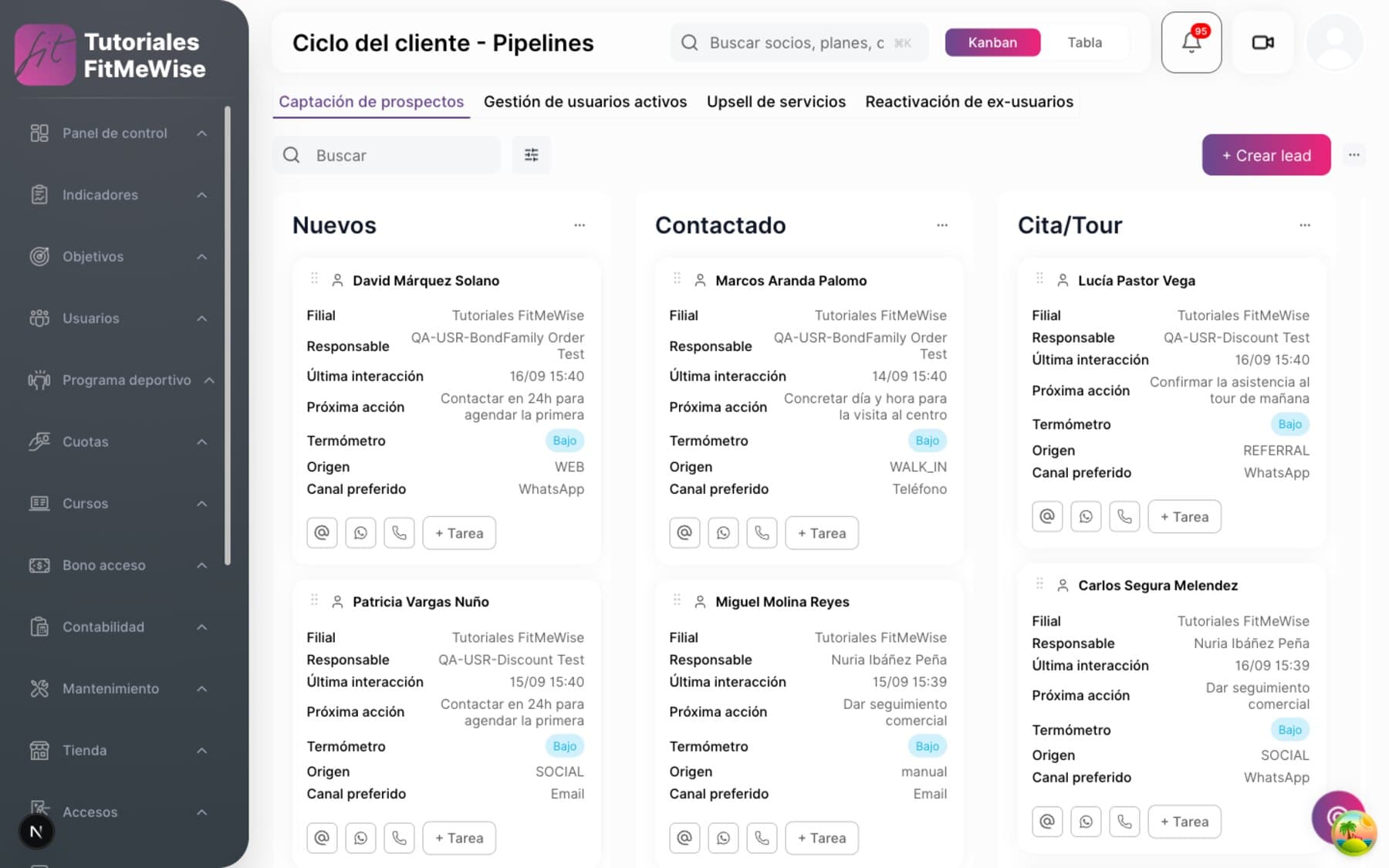
- An overdue task closes itself, at the exact minute
- A recurring task creates its next copy on its own, linked to the original
- The reminder before the due date is generated on time, but today we don't send it to anyone
Step by step: what happens when a task falls due or repeats
- Automatic due date. When the time comes, the task closes itself. The trigger comes from the same recurrence engine that schedules dates across the whole platform, and the command that closes it really runs in the database.
- Automatic repeat. When you mark a task as recurring, as soon as its cycle is complete the next copy is created on its own, linked to the one that originated it and keeping the exact time. The original task keeps its own trigger, with no mix-up with the new one.
- Reminder before the due date: half done. The trigger arrives on time and the reminder is generated, but today there is no channel connected behind it to send it: no email, no SMS, nothing. It fires and stops there. Coming soon.
A campaign's list is recalculated on every send
When your team hits send, the system looks at each member's profile, membership type, lifecycle stage and how many messages they have received recently. It is recalculated at that very moment, not against a list saved a month ago.
- Recalculated on every send, never against a list that goes stale
- Combines the member's profile, membership, lifecycle and recent messages
- Today your team triggers it by hitting send; sending by date or event is separate
What the engine looks at when calculating the audience
- A real engine, not saved lists. The query is recalculated every time you launch the campaign, with the rules you have defined on profile, membership, lifecycle and send fatigue.
- Triggered on send, still by hand. Today someone on your team has to hit send. Automatic campaign triggering by date or business event is in the section below, marked Coming soon.
You can already set this up; what's missing is for it to run by itself
The 35 sales, retention and payment-collection flows already run on their own from start to finish, with LAIA replying inside them. What's still to be connected is something else: scoring a lead with points and assigning it as owner to a sales rep without anyone touching it.
- Condition → action flows: they already run on their own, see the CRM and lifecycle module
- Lead scoring (by points): it can be defined, but there is no engine to calculate it yet
- Assigning the lead as owner to a sales rep: still done by hand
What already runs on its own, and what is still manual
- Condition → action flows, up and running. The catalog of 35 flows (acquisition, retention and payment collection) is activated one by one and runs on its own: WhatsApp first, email if there is no WhatsApp, LAIA replies if the lead answers, and a task is created if a person is needed. The detail is in the CRM and lifecycle module.
- Lead scoring, not yet. You define which events add points to a lead and which take them away. What's missing is for the system to calculate it on its own for every real lead; today a lead's temperature (high, medium, low) is set by a flow or by your team by hand, not by a points system.
- Assigning the lead as owner, still by hand. Round robin, fixed owner or lightest workload: the method is already saved. What's missing is for a new lead to be allocated automatically as owner on the kanban. What is shared out automatically today is the task a flow creates when someone needs to talk to the lead.
- Mass campaign triggered by date or event, still by hand. This is the email or SMS campaign in the communication section, different from the CRM flows: the schedule arrives on time, but the actual send still waits for someone to hit send.

What people tend to ask about this module
Does this already work, or is it just a plan?
It depends on the part. The 35 sales, retention and payment-collection flows, the due date and repeat of CRM tasks, and the audience calculation for a campaign all work today, for real, in production. Lead scoring by points and automatic assignment of the lead as owner can still be configured, but there is no engine to run them.
Is this artificial intelligence?
Both. Task due dates and repeats are a rules engine, with no language model. Inside a flow, however, LAIA really does reply to the lead or member and offers them the fee or class that suits them.
Can an inactive member receive an automatic message without anyone sending it?
Yes, with a flow. The “10 days without coming” flow messages them on its own by WhatsApp when they stop checking in; you activate it from the catalog of 35 flows, in the CRM and lifecycle module. What is still manual is sending a mass campaign by date or event.
What happens if a flow doesn't work as I expect?
You review and edit it in the editor before activating it again, and LAIA can edit it for you. Every flow keeps a history of which step each lead or member followed, so you can see where it breaks down.
Modules that often go with this one
- CRM and customer lifecycleEvery prospect with their stage, their owner and their follow-up date.See the module
- Multichannel bulk communicationYou pick the segment, launch the send, and know which channel really delivers today.See the module
- 24/7 customer service and sales support with AIYour member's thread already exists, with real email and SMS behind it. LAIA steps in to answer the repetitive questions.See the module
Want to see it working?
We'll show it to you with your own case: your fee types, your branches and whatever currently forces you to use two programs.
Request a demo